NEWS Delivering Expert English and Maths Tuitions !

📢 Looking For Best Tutor In Melbourne? You Are In The Right Place.

Selective Entry & Scholarships

Selective & Scholarship School Entry Exams

Preparation support for selective school and scholarship entry exams.

What This Program Covers

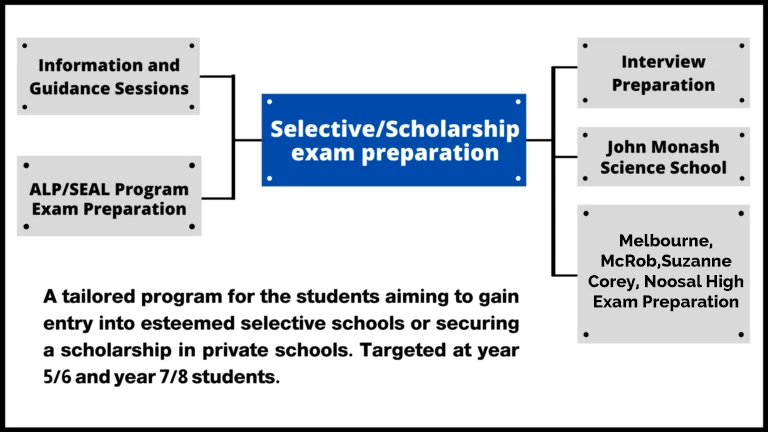
For students aiming for selective school placement or a private school scholarship, this program builds the English, mathematics, logic, and reasoning skills needed for competitive entry exams.

  • Targeted preparation across exam-style reading, writing, numeracy, and reasoning tasks.
  • Structured lessons that move from concept clarity to timed practice and review.
  • Support for confident problem solving under assessment conditions.

English Skills

Inference

The ability to digest written information and understand the underlying meaning of the text is known as inferential comprehension. This data is then utilised to infer or deduce deeper meaning that isn't presented clearly.

Author's Purpose

The objective of an author is reflected in the manner he writes about a subject. For example, if he wants to amuse people, he'll utilise jokes or tales in his work. Titles, prefaces, and the author's background can all provide clues about an author's intent.

Synthesizing

It necessitates the utilisation of multiple abilities and methods by pupils. Students should take frequent breaks to assess and reflect on what they've read. Readers generate new ideas and perspectives via synthesising. Students are made aware of how their thinking changes and grows as they read a material when they synthesise.

Text Analysis

Text analysis includes the following: What is the subject of the author's work? What is the author's perspective on their subject? What does the author say about the opposing viewpoint? Is there evidence to back up the author's position on the subject? Would you consider the argument to be persuasive as a reader? Can you think of any ways to make the case more compelling?

Summarising

Summarizing teaches pupils how to take a vast amount of literature and distil it down to essential aspects for easier comprehension. It's a technique that allows students to concentrate on important words and phrases in a text that are important to remember.

Character Traits

Students can deduce features about characters and observe them grow by analysing how they think, feel, and act (depending on the point of view). Character qualities require a lot of modelling!

Figurative Language

When you employ figurative language, you're using a term or phrase that doesn't have its usual, literal meaning. Metaphors, similes, personification, and hyperbole are just a few examples of how to utilise figurative language.

Determining the Main Idea

Is this paragraph about a specific individual or group of people? Is there a reference to time in the information? Is there a mention of a location in the text? Do you think there's a cause or an explanation for what happened? Is this information indicating a method or a hypothesis in any way?

Descriptive Writing

The purpose of descriptive writing is to let the reader imagine a character, an event, a location, or all of these things at once in great detail. The author might use all five senses to describe the scene.

Persuasive Writing

The goal of persuasive writing, also known as argumentation, is to persuade the reader to adopt the author's viewpoint. In their work, the authors will express personal beliefs and provide evidence to persuade the reader to agree with them.

Narrative Writing

The goal of narrative writing is to tell a tale, whether it's a true story or a made-up one. Characters will appear in narrative pieces, and the reader will learn what happens to them through the narrative.

Expository Writing

Expository writing is a type of writing that is used to impart facts (as opposed to fiction). It is the language that we use to learn and comprehend the world around us.

Mathematics Skills

Number Patterns

Finding a Pattern is a problem-solving method in which pupils search for patterns in data. Students look for items, numbers, or a series of occurrences that are repeated.

Algebra

Finding and describing patterns, generating generalisations about numbers, and utilising symbols and models to express patterns, quantitative relationships, and changes through time are all examples of algebraic thinking.

Graphs and Statistics

Points, lines, bars, and pie charts are all examples of graphs and charts, which are visual representations of data. One can illustrate figures measured in an experiment, sales statistics, or how your energy usage changes over time using graphs or charts.

Probability

The mathematics of probability and statistics is used to comprehend chance as well as to gather, organise, characterise, and analyse numerical data. This is necessary for students to determine the accuracy of an argument supported by seemingly persuasive data.

Equations and Inequality

Equations and inequalities are both mathematical sentences made up of two expressions connected by a relationship. The sign = indicates that the two expressions are judged equal in an equation. In an inequality, however, the two expressions are not always equal, as denoted by the symbols greater-than, less-than, or not-equal.

Geometry

Geometry is a branch of mathematics concerned with the study of shapes and figures. Geometry describes how to construct and draw shapes, as well as how to measure and compare them. Geometry is used in a wide range of tasks, from the construction of houses and bridges to the planning of space flight.

Measurement and Units

Finding a number that represents the amount of something is what measurement is all about. A measuring unit is a unit of measure for expressing a physical quantity.

Word Problems

Math word problems help students learn mathematical topics by applying them to real-life situations. We encourage students to think deeply about the issues by encouraging them to solve a variety of mixed word problems requiring students to comprehend the context before applying a solution.

Calculus

Calculus is a field of mathematics that helps us understand how values related to a function change over time. Many of these formulas are time functions, and one way to think about calculus is as a study of time functions.

Functions

A function can be thought of as a rule that assigns or translates each member x of a set to the same value y known as its image.

Trigonometry

Trigonometry is a branch of mathematics that is used in a variety of fields. Simply described, trigonometry is the science of triangles and the lengths and angles of their sides.

Reasoning & Problem-Solving Skills

Problem Solving Techniques

Problem-solving abilities can be evaluated in three ways: by asking for examples of times when you have previously solved a problem; by presenting you with hypothetical situations and asking how you would respond; and by observing how you apply your problem-solving skills to various tests and exercises.

Analytical Reasoning

Analytical reasoning examinations evaluate a candidate's ability to analyse data and apply logic to uncover patterns or draw conclusions.

Verbal Reasoning

The ability of a learner to extract and deal with meaning, information, and implications from text is determined by verbal reasoning tests. The verbal reasoning test is used to evaluate English comprehension skills. Making deductions from text, word definitions, and other things are possible, but the most typical style is a text passage with multiple-choice questions.

Numerical Reasoning

You must answer questions utilising facts and figures presented in statistical tables in a numerical reasoning test. In most cases, the student will be offered a number of options to pick from while answering a question. In each example, just one of the possibilities is correct.

Mind Maps

Mind maps are ideal for generating and capturing ideas, taking notes, planning, collaborating with friends, and visualising complicated concepts simply and enjoyably.

Understanding Victoria’s Selective & Scholarship School Entry Exams

Victoria offers several pathways for academically capable students to gain entry into selective government schools and leading private schools. These entrance examinations assess a wide range of skills beyond classroom learning.

Students are commonly tested on:

  • Mathematics and numerical reasoning
  • Reading comprehension
  • Verbal reasoning
  • Creative and persuasive writing
  • Logical reasoning
  • Critical thinking skills
  • Problem-solving abilities

Preparing for these exams requires more than memorising concepts. Students need to develop speed, accuracy, reasoning skills, and effective exam strategies.

Our selective entry exam tutoring programs help students understand exam formats, improve academic skills, and build confidence before test day.

ACER Selective & Scholarship Exam Preparation

The Australian Council for Educational Research (ACER) conducts various entrance examinations used by many independent schools and scholarship programs across Australia.

ACER-style exams focus on assessing a student’s ability to think critically and apply knowledge in unfamiliar situations.

Our ACER preparation program helps students develop:

  • Advanced reading comprehension skills
  • Mathematical reasoning techniques
  • Verbal reasoning strategies
  • Abstract reasoning abilities
  • Exam time management skills
  • Confidence with challenging questions

Through regular practice and feedback, students learn how to approach different question types effectively and improve their overall performance.

Edutest Scholarship Exam Preparation Melbourne

Many private schools use Edutest assessments as part of their scholarship and entry selection process. These exams evaluate students across multiple academic areas and require strong preparation.

NRICH Learning provides structured scholarship exam preparation to help students become familiar with Edutest-style questions and develop essential exam skills.

Our Edutest preparation includes:

  • Reading comprehension practice
  • Mathematical reasoning activities
  • Written expression improvement
  • Vocabulary development
  • Problem-solving exercises
  • Timed practice tests

Students learn how to manage exam pressure, improve accuracy, and approach challenging questions with confidence.

AAS Selective & Scholarship Exam Preparation

The Academic Assessment Services (AAS) examination is another commonly used assessment for selective school and scholarship entry.

AAS-style tests evaluate students’ academic ability, reasoning skills, and written communication.

Our preparation program supports students with:

  • Reasoning skill development
  • Advanced problem-solving techniques
  • Writing improvement
  • Exam strategy training
  • Practice assessments

By developing these skills early, students are better prepared to handle the demands of selective and scholarship examinations.

Preparing for Melbourne’s Selective Schools

Melbourne has some of the most competitive selective and scholarship-based schools in Australia. Successful preparation requires early planning and consistent skill development.

NRICH Learning helps students prepare for:

  • Selective entry examinations
  • Private school scholarship tests
  • High school entrance examinations
  • Academic ability assessments

Students learn how to:

  • Think critically
  • Solve complex problems
  • Manage examination time effectively
  • Write structured responses
  • Approach unfamiliar questions confidently

High School Tutoring

The transition from primary school to high school is an important milestone. Many students require additional support when preparing for competitive entrance examinations.

Our High School tutoring helps students strengthen academic foundations and prepare for challenging assessments.

Whether students are applying for selective government schools or private school scholarships, NRICH Learning provides the guidance needed to improve preparation and confidence.

Why Choose NRICH Learning for Selective & Scholarship Exam Preparation?

NRICH Learning provides expert tutoring programs designed specifically for competitive school entry exams.

Students benefit from:

Experienced selective exam tutors
Structured preparation programs
Comprehensive practice materials
Small-group learning environment
Personalised feedback
Exam-focused strategies

Start Your Selective School Preparation Journey Today

Enquire Today